JobScheduler
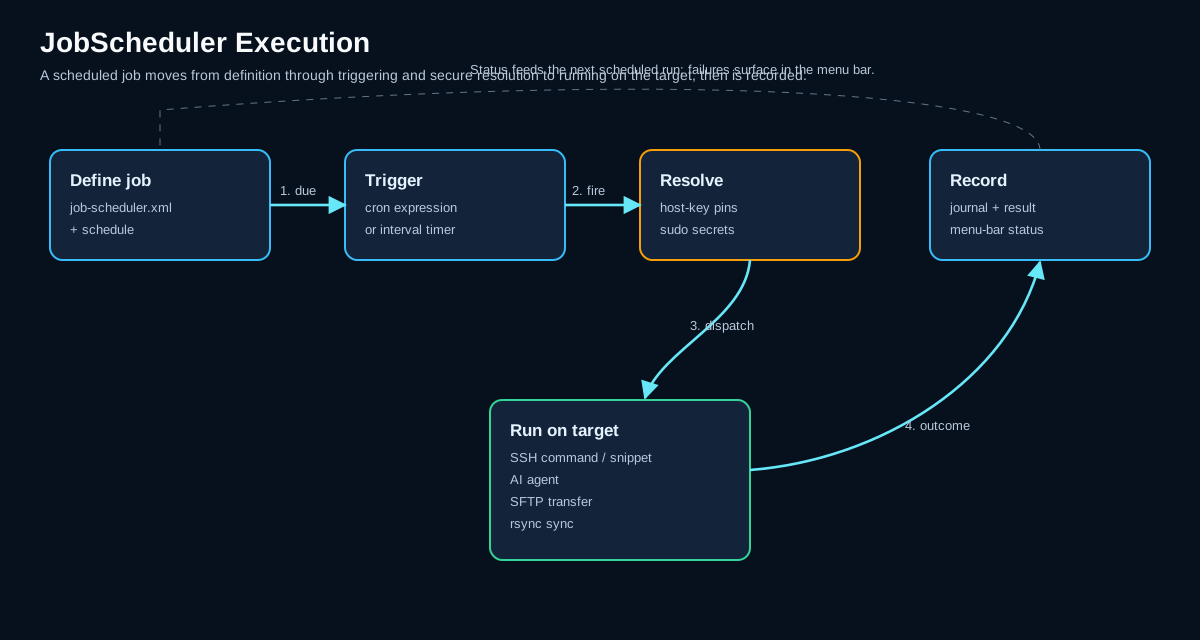
The JobScheduler runs unattended background jobs while KorTTY is open. It does not require an operating system service or an active SSH terminal tab. Jobs execute automatically on a configured schedule using saved SSH connections from the Connection Manager.
On macOS and Windows, an enabled job with a future run keeps the computer from entering system sleep while korTTY is running when Configuration > Prevent System Sleep is enabled, so the scheduled time remains reachable. The Scheduler uses a single wake-up for the next due run and owns no polling timer when no enabled future job exists. With no terminal connection, future or running Scheduler job, or active AI request, system sleep remains available even while the setting is checked. While a job is running, macOS does not put korTTY into App Nap. Display sleep is not blocked. Linux power inhibition is not yet supported.
Open it with Tools > JobScheduler.... The dialog remembers its window position and size. The German interface now translates all labels, action names, status values, validation messages, target selectors and supporting prompts; technical protocol and format names such as SFTP, Rsync, ZIP, TAR, stdout and stderr remain unchanged.
Overview
JobScheduler supports six types of actions:
- COMMAND — Run a non-interactive remote shell command
- SNIPPET_SCRIPT — Execute a SnippetManager script on the target with optional parameters
- AI_AGENT — Run a headless AI agent with explicit auto-approval
- AI_SWARM — Broadcast one AI-agent task to all selected targets in parallel and store the combined answer as a saved swarm chat
- SFTP — Upload, download, sync, delete, rename, create directories, set permissions, change ownership, remote-copy, or create archives
- RSYNC_SYNC — Synchronize directories via external
rsyncover SSH
Job Configuration
The JobScheduler dialog has three tabs: Job, Action, and Journal.
Job Tab: Targets and Schedules
Use the Job tab to define where and when a job runs.
| Field | Description |
|---|---|
| Enabled | Enables or disables the job. |
| Name | Display name shown in the job list, journal, and menu-bar status. |
| Connection | Opens the Connection Manager selection dialog. Select individual SSH TCP servers, whole groups, or both. Mosh connections are not supported. |
| Working directory | Optional remote directory. Use Browse... to connect to the target and pick a directory when the path is not known. |
| Journal | LIMITED_REDACTED stores bounded, redacted excerpts. FULL stores full output/transcripts (KorTTY-managed secrets are still redacted). |
| Active from / Active until | Optional date range for the job. The job will not run outside this range. |
| Window start / Window end | Time window for the job (e.g., 09:00 to 17:00). Values are selected from validated time lists. |
| Interval minutes | Optional repeated interval inside the active window. If set, the job runs every N minutes between window start and end. |
| Fixed times | Optional explicit start times (e.g., 09:30, 12:00, 15:30). Values are selected from validated time lists. |
| Weekdays | Optional weekday filter. Use the all-toggle to select or clear all weekdays at once. |
Schedule calculations use the local system time zone. If no fixed time and no interval are configured, the next run is the window start on an allowed date.
Note
Scheduler jobs support saved SSH TCP connections only. Mosh targets are blocked as unsupported and the reason is written to the journal.
Host Keys, Sudo, and Secrets
Host-key verification is secure by default. Before unattended SSH/SFTP/Rsync execution, select the target and click Confirm host key so KorTTY stores the pinned fingerprint and OpenSSH public-key material.
The checkbox Disable host-key verification for this job disables host-key verification only for the selected job. This is unsafe and should only be used when the risk is understood.
Sudo passwords can be stored for one server or for a server group:
- Server-specific sudo passwords are used first.
- Group sudo passwords are used as fallback.
- Stored sudo passwords are encrypted with the master password.
- If the master password is locked and a job needs SSH, sudo, API, or archive secrets, the job is blocked and journaled.
For Rsync jobs, Use sudo means passwordless remote sudo only through sudo -n rsync. Stored sudo passwords are not used by the current Rsync integration.
Action Tab: Job Types and Configuration
Use the Action tab to choose what the job does. The tab shows only the fields that the selected action can use, so unrelated fields are hidden. The action selector includes:
| Action | Purpose |
|---|---|
| COMMAND | Run a non-interactive remote command. |
| SNIPPET_SCRIPT | Run a SnippetManager script on the selected target. The Snippet search field filters the script dropdown by snippet name, category, language, or ID; Snippet parameters passes additional arguments as one argv value per line. |
| AI_AGENT | Run the headless scheduler AI agent. Unattended command execution requires Auto-approve AI commands on the job. |
| AI_SWARM | Run the AI Swarm headlessly on every selected target in parallel and combine the answers into one comparison table. |
| SFTP_UPLOAD | Upload a local path to a remote path. |
| SFTP_DOWNLOAD | Download a remote path to a local path. |
| SFTP_SYNC | Synchronize local and remote paths in the selected upload/download direction. |
| SFTP_DELETE | Delete a remote path. |
| SFTP_RENAME | Rename a remote path. |
| SFTP_MKDIR | Create a remote directory. |
| SFTP_CHMOD | Change permissions. Numeric modes such as 755 and symbolic modes such as u+rw,o-w are accepted. |
| SFTP_CHOWN | Change owner and/or group. Owner and group buttons can query the target and show available values. |
| SFTP_COPY_REMOTE | Copy a remote path to another remote path on the same target. |
| SFTP_ARCHIVE | Create a remote archive. |
| RSYNC_SYNC | Synchronize one or more directories via external rsync over SSH. |
Path fields provide local Finder/Explorer selection where the path is local and remote directory browsing where the path is remote. Remote browsing requires a selected target and host-key verification unless the job explicitly disables host-key verification.
Snippet Script Jobs
Snippet script jobs use the selected SnippetManager entry without requiring an open terminal tab. KorTTY resolves built-in snippet variables and stored SnippetManager variables before execution. Missing snippets, missing stored variable values, and unsupported snippet languages block the job and write the reason to the journal. Additional snippet parameters are entered one per line so values with spaces are passed as single script arguments.
AI Swarm Jobs
AI Swarm jobs run one AI-agent prompt on all selected targets in parallel over background SSH sessions — no terminal tabs are opened. Beyond the shared AI profile, AI prompt, and Auto-approve AI commands fields, two swarm-specific fields apply:
| Field | Description |
|---|---|
| Swarm parallelism | How many targets run concurrently (1–16, default 4). |
| Swarm read-only | Restricts every agent to non-mutating commands. On by default. |
Results are stored twice: the journal records the run outcome, and the full conversation — including the combined per-server comparison table — is saved as a swarm chat that can be reopened from the AI Manager's Swarm Chats section.
The fastest way to create an AI Swarm job is the Schedule… button in the AI Swarm tab: it prefills a new job with the tab's current targets, prompt, AI profile, and read-only setting. See that page for recommended swarm/scheduler usage scenarios.
Warning
A scheduled swarm with Swarm read-only off and Auto-approve AI commands on changes systems unattended. Test the prompt interactively in the AI Swarm tab before enabling such a job.
SFTP Archive Jobs
SFTP archive jobs support ZIP, password-protected ZIP, TAR, and TAR.BZ2. Archive sources and exclude patterns accept one path or pattern per line. The archive can optionally be downloaded after creation.
When Use sudo staging for SFTP paths is enabled, KorTTY stages files in a temporary location and uses sudo-assisted remote commands such as mv, cp, tar, chmod, and chown where elevated rights are required. Cleanup failures are written to the journal.
Rsync Jobs
RSYNC_SYNC supports upload and download between the local filesystem and saved SSH TCP connections.
- Upload: local source directories are synchronized under the remote target root.
- Download: remote source directories are synchronized under the local target root.
- Multiple sources are supported.
- Delete missing files adds
--delete; it is off by default. - For downloads from multiple group targets, KorTTY writes each target into its own subdirectory below the local target root to avoid overwriting files from another server.
KorTTY builds Rsync execution as a ProcessBuilder argument list instead of shell-concatenating the command. The command uses -a --itemize-changes; --delete is added only when the job checkbox is enabled.
Rsync Prerequisites
rsyncis taken fromPATH, unless an explicit binary path is configured in Settings > SFTP > JobScheduler Rsync.sshmust be available inPATH.- Host-key pinning is required unless the job explicitly disables host-key verification.
- Password and private-key passphrase authentication use a temporary owner-only
SSH_ASKPASShelper. Secrets, helper paths, and temporary secret-file paths are redacted before journaling.
Journal Tab
The Journal tab lists job runs with local KorTTY timestamps, status, job name, and summary. The columns Started, Status, Job, and Summary are sortable; the default order shows the newest started entries first.
The search row can match all persisted journal fields or only selected columns such as status, job, summary, stdout, stderr, and detail. Enter multiple whitespace-separated terms when every term must occur somewhere in the selected search scope; use * inside a term as a wildcard, for example backup*fail.
Selecting a row shows stdout, stderr, and detail text. Use Delete selected to remove selected journal entries. By default, KorTTY automatically deletes scheduler journal entries older than 14 days; set the retention value to 0 to keep entries indefinitely.
The protocol/detail area below the table is separated by a vertical splitter. Resize it to give the output more or less height; KorTTY stores that divider position in the global settings. In the detail text area, mark text and right-click to copy the selected text to the clipboard.
Journal statuses include successful, failed, blocked, cancelled, and running/system entries. Reasons such as locked master password, missing host-key pin, missing rsync/ssh, unsupported Mosh target, or shutdown drain are written as journal details.
Menu-Bar Status and Cancellation
When Show Jobs status in menu bar is enabled, KorTTY shows the scheduler status after Help only if an enabled scheduler entry exists or a job is currently running. The status shows the running job, cancellation state, or the next job with a live countdown.
Click the status menu to see:
- Open JobScheduler...
- running jobs and cancel entries
- up to five next queued jobs with start time and live countdown
Right-click the status label for a compact menu with cancel actions for running jobs and a shortcut to open JobScheduler. Cancellation requests are journaled and running SSH/Rsync work is interrupted cleanly where possible.
Quitting KorTTY While Jobs Run
If KorTTY is about to exit while JobScheduler jobs are running, it shows a warning with the active job names. Choosing Cancel keeps KorTTY running. Choosing Wait and quit starts shutdown drain mode:
- new scheduled or manual job starts are blocked;
- the shutdown wait is written to the journal;
- KorTTY waits for running jobs to complete or cancel;
- KorTTY exits automatically after the drain finishes.
Security and Secrets
- Host keys are pinned by default to prevent man-in-the-middle attacks on unattended execution.
- Sudo passwords are stored encrypted with the master password.
- SSH key passphrases and archive passwords are stored encrypted.
- KorTTY redacts managed secrets (passwords, passphrases, archive credentials) from journal output before persistence.
- If the master password is locked when a job needs SSH, sudo, API, or archive secrets, the job is blocked.
Troubleshooting
Warning
JobScheduler job is blocked: Open Tools > JobScheduler... > Journal and inspect the selected entry's detail text. Common causes are:
- Locked master password
- Missing host-key pin
- Unsupported Mosh target
- Missing rsync or ssh in PATH
- Old host-key pin without OpenSSH public-key material for Rsync
JobScheduler Rsync cannot start: Verify local rsync --version and ssh -V, or configure the Rsync binary path in Settings > SFTP > JobScheduler Rsync.
JobScheduler remote browser cannot open: Select exactly one target and confirm the host key first, unless the job explicitly disables host-key verification.