Teamwork (shared connections)
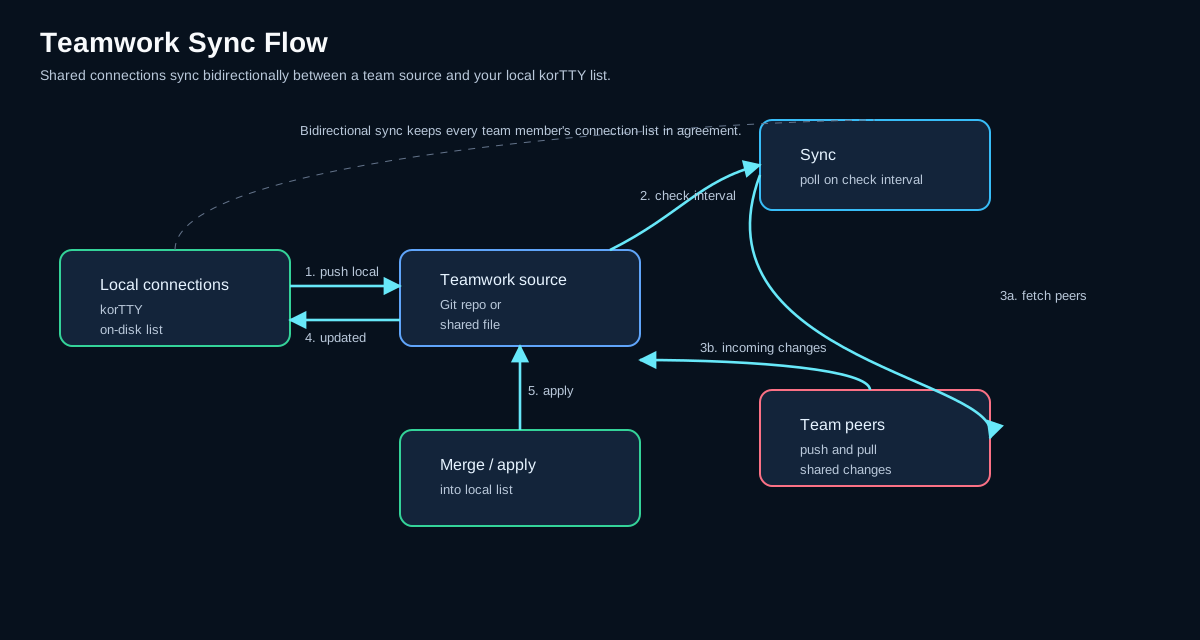
Share SSH connections with your team by syncing them from a Git repository or shared file. Teamwork sources are loaded into the Connection Manager alongside your local connections, kept in sync automatically, and safely stripped of inline passwords so credentials come only from your local encrypted storage.
Overview
Teamwork lets teams maintain a centralized library of connection configurations:
- Git repositories — Clone and keep in sync with a Git repo containing a
kortty-teamwork-connections.xmlfile (or legacyconnections.xml). - Shared files — Load connections from a local or network path (read-only or read-write).
- Automatic sync — Background syncing at a configurable interval checks for updates.
- Credential security — Shared connections do NOT carry inline passwords; only credential IDs and SSH key references.
- Local overrides — Your local credentials and SSH keys are merged with shared connection definitions.
- Read-only mode — Mark sources as read-only to prevent accidental writes back.
Setting up teamwork sources
Open Teamwork → Teamwork Settings… (or Configuration → Global Settings… → Teamwork) to configure sources.
Add a source
- Click Add to create a new source.
- Choose the source Type:
- Git — Clone from an HTTPS, SSH, or git:// URL.
- Shared File — Read from a local or network path (e.g.,
file:///mnt/share/connections.xmlor//host/share/connections.xml). - Enter the Location:
- For Git: the clone URL.
- For Shared File: a local/network file path (can be a file:// URI or a UNC path).
- Set the Check Interval (1–1440 minutes; default: 15).
- Optionally enable Read-Only to prevent writes back (Git sources only).
- Click OK to save.
Manage sources
The Teamwork Settings dialog lists all sources with their type, location, and sync interval:
| Column | Meaning |
|---|---|
| Type | Git or Shared File |
| Location | Repository URL or file path |
| Interval | Minutes between sync checks |
| Enabled | Toggle to enable/disable without deleting |
Use the buttons to: - Add — Create a new source. - Edit — Modify the selected source. - Remove — Delete the selected source. - Enable/Disable — Toggle the enabled state for the selected sources.
At the bottom, set the Default Check Interval (applies to new sources that don't specify one).
How synchronization works
Background sync
Once you save the Teamwork Settings:
- KorTTY starts a background sync thread.
- Every N minutes (based on the minimum interval among enabled sources), it:
- Pulls/clones each source (Git) or reads the file (Shared File).
- Loads the connections XML.
- Merges the results into the cache and Connection Manager.
- If a source update fails, the previous cached version is kept.
Manual sync
Use Teamwork → Teamwork Settings… and click OK to trigger a sync immediately.
Conflict detection
Each sync records a version token: - Git — The current commit hash. - Shared File — The file's last-modified timestamp.
If a shared connection's version token changes between syncs, a new version was fetched. If you have made local edits to a teamwork connection and the source updates with a conflicting change, the local edits are preserved (no automatic overwrite).
Shared connection file format
Create a kortty-teamwork-connections.xml file (or connections.xml for backward compatibility) in the root of your Git repo or shared file:
<?xml version="1.0" encoding="UTF-8"?>
<connections>
  <connection id="prod-web-1">
    <name>Prod Web Server 1</name>
    <host>web1.example.com</host>
    <port>22</port>
    <username>deploy</username>
    <group>Production/Web</group>
    <authMethod>SSH_KEY</authMethod>
    <sshKeyId>key-prod-deploy</sshKeyId>
    <credentialId>cred-prod-user</credentialId>
  </connection>
</connections>
Do not include inline secrets
Teamwork connections must not include encryptedPassword, privateKeyPath, or privateKeyPassphrase. Instead:
- Use credentialId to reference a stored credential in Security → Credentials….
- Use sshKeyId to reference a stored SSH key in Security → SSH-Keys….
If inline secrets are found in the shared file, KorTTY strips them automatically (they are not loaded).
Using teamwork connections
Once a source is synced:
- Open Manage Connections… (or press Ctrl+M).
- Teamwork connections appear in the tree with a [Teamwork] label and their source ID.
- Click a teamwork connection to view or use it.
- Cannot edit directly — Teamwork connections are read-only unless their source is marked as writable and you own edit rights (determined by
teamworkRole).
Local overrides
- The merged credential and SSH key references are resolved from your local storage.
- If a credential or key is not found locally, you are prompted to provide it when connecting.
- Your local copy of a teamwork connection can override authentication by assigning a different credential or key.
Distinguish sources
In the Connection Manager, teamwork connections are marked by their source ID. Hover over or inspect the connection properties to see which teamwork source it came from.
Git repository setup
To share connections via Git:
- Create a repository (e.g.,
ssh-connections). - Add a
kortty-teamwork-connections.xmlfile to the root with your connection definitions. - Commit and push.
- Share the repository URL (HTTPS or SSH) with team members.
- Team members add the URL in Teamwork → Teamwork Settings… → Add.
SSH vs. HTTPS
- HTTPS — Works without SSH key setup; may require a GitHub Personal Access Token or username/password (store the token securely).
- SSH — Requires
gitand a local SSH key in~/.ssh/id_rsa(or configured inssh-add).
Example repository layout
Optional: store versions in Git
Use the commit hash as the version token so KorTTY can detect updates:
Shared file setup
To share connections via a file:
- Export your connections to a file: Connections → Export… → select connections → save as
.xml. - Place the file on a shared network path (e.g.,
//server/share/connections.xml). - Set read/write permissions as needed.
- Team members add the file path in Teamwork → Teamwork Settings… → Add.
Example paths
| Platform | Path format |
|---|---|
| Windows (network share) | //server/share/connections.xml or file:////server/share/connections.xml |
| Linux/macOS (NFS mount) | /mnt/teamshare/connections.xml or file:///mnt/teamshare/connections.xml |
| SMB/CIFS (mounted) | /Volumes/teamshare/connections.xml (macOS) |
Security considerations
Credentials are local-only
Shared connections do not carry passwords or key passphrases. Your local encrypted storage (master-password protected) holds the actual secrets. Team members must have their own credentials set up locally.
Git repositories should not store secrets
Never commit passwords, SSH key content, or API tokens to the teamwork repository. Use only credential IDs and key references.
File permissions
For shared files on network paths, restrict read/write access to team members only. Ensure the path is not world-readable.
Audit trail
For Git-based teamwork, the commit history provides an audit trail. Review changes before pulling by checking the remote branch.
Troubleshooting
Source is not syncing
- Open Teamwork → Teamwork Settings….
- Verify the source is Enabled.
- Check that the Location is correct and accessible:
- Git — Run
git clone <url>manually to test. - Shared File — Verify the file exists and is readable from your machine.
- Click OK to trigger a manual sync.
- Check the application log (
~/.kortty/kortty.log) for errors.
Connections appear but credentials are missing
- Open Security → Credentials… and Security → SSH-Keys….
- Verify that the credential IDs or SSH key IDs in the shared connections exist locally.
- If missing, add them manually or ask your team administrator to provide the IDs.
Cannot push changes to Git repo
- Verify the Git URL uses SSH or an HTTPS token (not username/password).
- Ensure your SSH key is registered with the remote (GitHub, GitLab, etc.).
- In Teamwork Settings, mark the source as Read-Only if you don't need to write back.
File path is not recognized (Windows/UNC)
Use forward slashes or the file:// URI format:
//server/share/connections.xml✓\\server\share\connections.xml✗ (backslashes may not parse correctly)file:////server/share/connections.xml✓ (UNC notation)