SFTP file manager
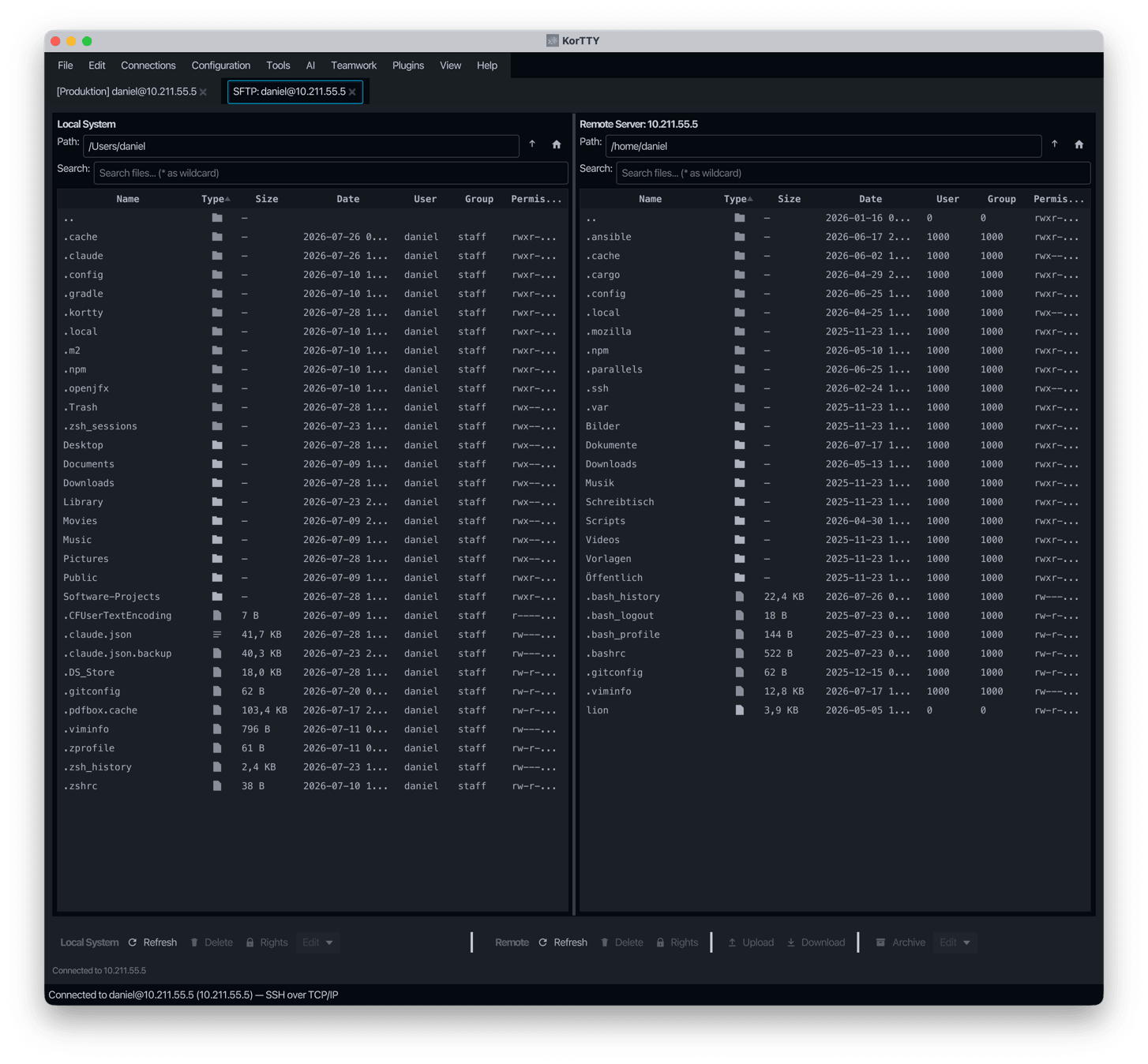
The integrated SFTP Manager provides a graphical file manager for transferring files between your local machine and remote servers via SFTP. It features a dual-panel layout, full file operations support, and seamless integration with the Snippet Editor for remote file editing.
Opening SFTP Manager
You can open the SFTP Manager in two ways:
- Menu: Tools > Open SFTP Manager
- Dashboard: Right-click a connection > "Open SFTP Manager"
If the connection uses a temporary SSH key that has expired, you will be prompted to enter a new key before the connection can proceed.
Interface
The SFTP Manager uses a two-panel layout for easy side-by-side file management:
| Left Panel (Local) | Right Panel (Remote) |
|---|---|
| Browse local files | Browse remote files |
| Upload to remote | Download to local |
Sortable columns
Both panels display the same columns, all of which are sortable by clicking the column header:
| Column | Description |
|---|---|
| Name | File or directory name |
| Type | Directory (📁) or file (📄) indicator |
| Size | File size in human-readable format (directories show —) |
| Date | Last modified date and time |
| User | Owner name (local: from filesystem; remote: from SFTP or UID) |
| Group | Group name (local: from filesystem; remote: from SFTP or GID) |
| Permissions | Unix-style permissions (e.g., rwxr-xr-x) |
Default sort order
By default, files are sorted by the Type column in this order:
- Parent directory (
..) — always at the top - Directories starting with "." (e.g.,
.git,.config) — alphabetically - Other directories — alphabetically
- Files starting with "." (e.g.,
.bashrc) — alphabetically - All other files — alphabetically
Click any column header to sort by that column. Clicking the Type column again toggles between ascending and descending order.
File operations
The SFTP Manager supports a full range of file operations:
| Operation | How |
|---|---|
| Upload | Select local file(s), click Upload (or drag and drop) |
| Download | Select remote file(s), click Download |
| Delete | Select file(s), click Delete |
| Rename | Select a file, click Rename |
| Copy | Copy files within the same panel |
| Edit in Snippet Editor | Select exactly one local or remote file, then use the Edit toolbar menu or the right-click context menu |
| Create Directory | Click "New Folder" in either panel |
| Create ZIP | Select multiple files/directories, click "Create ZIP" |
| Set Owner/Permissions | Select file(s), use context menu or button. Separate fields for User, Group, and octal permissions (e.g., 755) |
Editing files with Snippet Editor
The Edit in Snippet Editor action is enabled only for a single selected file. It is disabled for:
- Folders
- The parent-directory entry (
..) - Multiple selections
Local files are read directly from the local filesystem; remote files are downloaded through the active SFTP session into the editor.
When the file opens in the Snippet Editor, the full toolbar remains available, including:
- Formatting and syntax checking
- Editor profiles and styling
- Line numbers and word wrap
- Configured AI actions
The file-mode buttons provide these save choices:
- Overwrite file — writes the current editor content back to the original local or remote file
- Save as... — writes a new local file through a file chooser, or for remote files prompts for a new file name in the same remote directory
- Save as snippet — stores the current content as a new Snippet Manager snippet without marking the source file as saved
Search
Both panels support glob pattern search using the * wildcard. For example:
*.logfinds all log files in the current directory*.{py,sh}finds Python and shell files (if your shell supports brace expansion)backup*finds all files starting with "backup"
Enter the pattern in the search field to quickly filter displayed files without leaving the current directory.