Terminal
Configure terminal display and behavior settings, including dimensions, scrollback, character encoding, and SSH connection management. Open via Configuration → Global Settings → Terminal; stored in ~/.kortty/global-settings.xml.
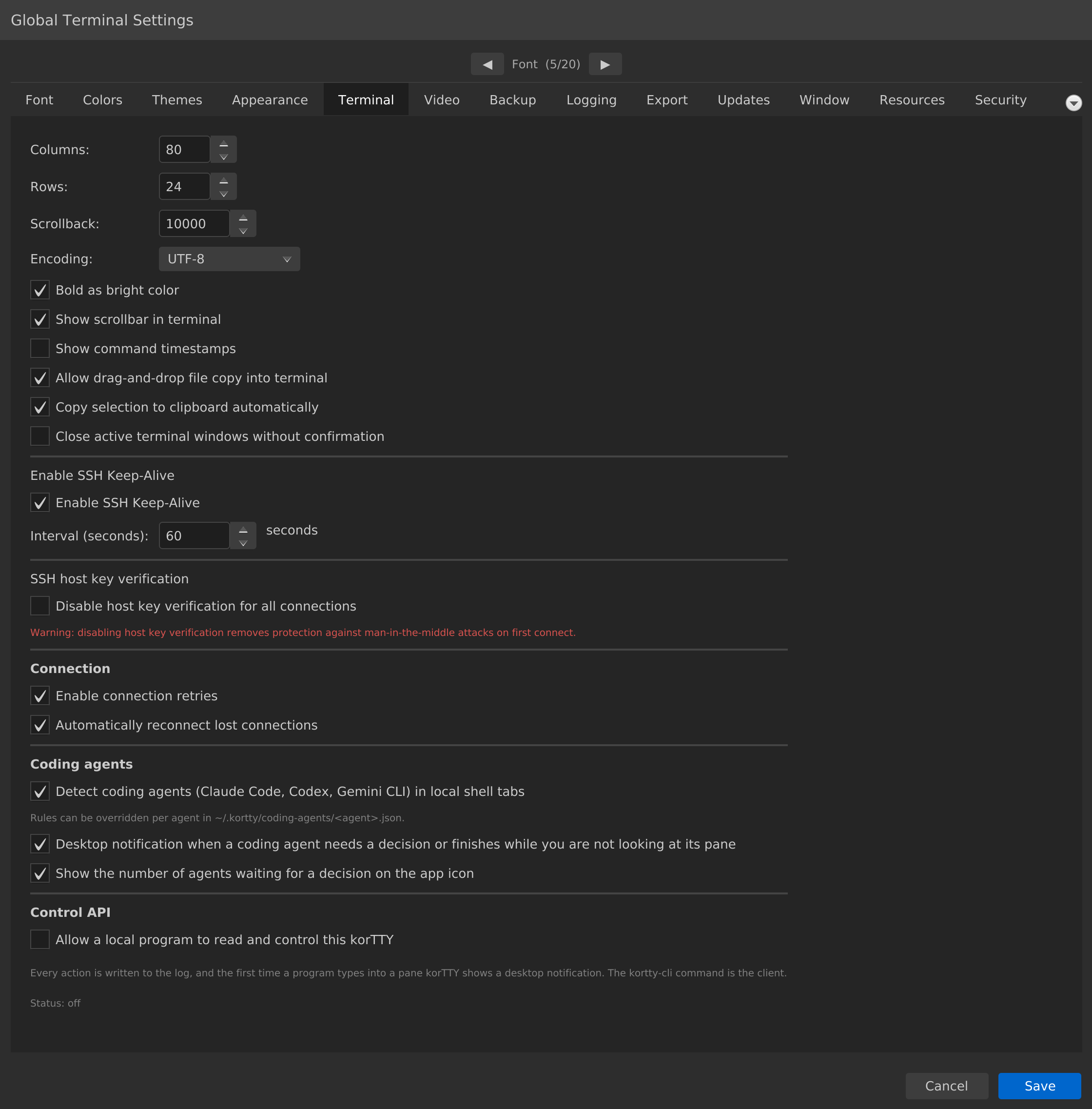
| Setting | Type | Values | Default | Stored as |
|---|---|---|---|---|
| Columns: | number | 40–500 | 80 | terminalColumns |
| Rows: | number | 10–200 | 24 | terminalRows |
| Scrollback: | number | 100–100,000 | 10,000 | scrollbackLines |
| Encoding: | dropdown | UTF-8, ISO-8859-1, ISO-8859-15, Windows-1252 | UTF-8 | encoding |
| Bold as bright color | toggle | — | On | boldAsBright |
| Show scrollbar in terminal | toggle | — | On | showTerminalScrollbar |
| Show command timestamps | toggle | — | Off | commandTimestampsEnabled |
| Allow drag-and-drop file copy into terminal | toggle | — | On | terminalDragDropEnabled |
| Copy selection to clipboard automatically | toggle | — | On | terminalCopyOnSelectEnabled |
| Close active terminal windows without confirmation | toggle | — | Off | closeActiveTerminalWindowsWithoutConfirmation |
| Enable SSH Keep-Alive | toggle | — | On | sshKeepAliveEnabled |
| Interval (seconds): | number | 5–600 | 60 | sshKeepAliveInterval |
| Enable connection retries | toggle | — | On | connectionRetriesEnabled |
| Automatically reconnect lost connections | toggle | — | On | autoReconnectEnabled |
| Disable host key verification for all connections | toggle | — | Off | hostKeyCheckDisabledForAllConnections |
| Detect coding agents (Claude Code, Codex, Gemini CLI) in local shell tabs | toggle | — | On | codingAgentDetectionEnabled |
| Desktop notification when a coding agent needs a decision or finishes while you are not looking at its pane | toggle | — | On | codingAgentNotificationsEnabled |
| Show the number of agents waiting for a decision on the app icon | toggle | — | On | codingAgentAppBadgeEnabled |
| Allow a local program to read and control this korTTY | toggle | — | Off | controlApiEnabled |
Notes
Scrollback
Controls how many lines of output each terminal pane keeps in its scrollback buffer. The value is read when a terminal is created, so a change applies to newly opened tabs and split panes — already-open terminals keep their current buffer size. Larger values use more memory per pane.
SSH Keep-Alive
When enabled, korTTY sends periodic keep-alive packets to prevent SSH sessions from timing out during idle periods. The interval setting controls how often (in seconds) these packets are sent. The spinner range is 5–600 seconds; the interval is disabled if SSH Keep-Alive is toggled off.
Disable host key verification for all connections
This is the global, lowest-precedence host-key setting: it relaxes verification to accept-new for every connection that does not set its own or its group's override. Accept-new still hard-blocks a changed key on a host already pinned, and a jump server's own key is always verified strictly — but disabling first-use verification removes protection against a man-in-the-middle on the very first connection. Off by default. Per-connection and per-group overrides are set in the Connection Manager; see Security → Relaxing host-key verification.
Drag-and-Drop File Copy
When enabled, you can drop files or folders from your file manager (Finder on macOS, Explorer on Windows) directly into the terminal window. The files will be copied to the remote SSH server via SFTP.
Command Timestamps
When enabled, a sidebar appears on the left side of the terminal displaying the date and time each command was entered, useful for audit trails and session logging.
Connection Retries
When enabled, failed SSH connections are automatically retried. Disabling this prevents automatic reconnection attempts for failed connections.
Retries only cover failures that a further attempt could resolve. A changed host key, a Mosh connection configured with a jump server, or a missing Mosh runtime is refused immediately regardless of this setting.
Automatically reconnect lost connections
When enabled and an established SSH connection is lost (network drop, server gone), the tab reconnects on its own with increasing delays — 3, 5, 10, 20, 30, then every 60 seconds — and the red status bar counts down to the next attempt. A double-click on the bar still reconnects immediately, and a successful reconnect or closing the tab stops the automatic attempts. Failed logins and other permanent failures (authentication, host key, configuration) are never retried automatically, and a connection that never got established is not retried by this setting either — that is what Enable connection retries covers. See Terminal sessions → Connection loss.
Allow a local program to read and control this korTTY
This is the Control API, and it is the only setting in this tab that is off by default. While it is on, any program running under your user account on this computer can list your windows, read every open pane — local shells and SSH sessions alike — and type into them, including pressing Enter. Nothing is reachable over the network and no other user of the computer can connect, but that is the extent of the boundary: within your own account it is the same power as sitting at your keyboard. A status line under the checkbox reports what the listener is actually doing, because the checkbox and the listener can legitimately disagree — enterprise policy can deny the feature, and a start can fail because another korTTY already owns the socket. Every action is logged with byte counts only, never terminal text, and the first time a program types into a pane you get one desktop notification. See Control API for the security model and Control CLI for the kortty-cli client that speaks it.
Detect coding agents
When enabled, korTTY watches every local shell pane for a running Claude Code, Codex or Gemini CLI and tracks whether it is working, blocked on a question, done or idle. The screen is analysed locally and nothing leaves the computer; the change applies immediately to open tabs. The two toggles below it control the desktop notification for an agent that needs a decision or finishes while you are not looking at its pane, and the count of waiting agents on the app icon (or in the window title where no icon badge exists); both read the setting live, so a change applies at once. See Coding agents.