Main window overview
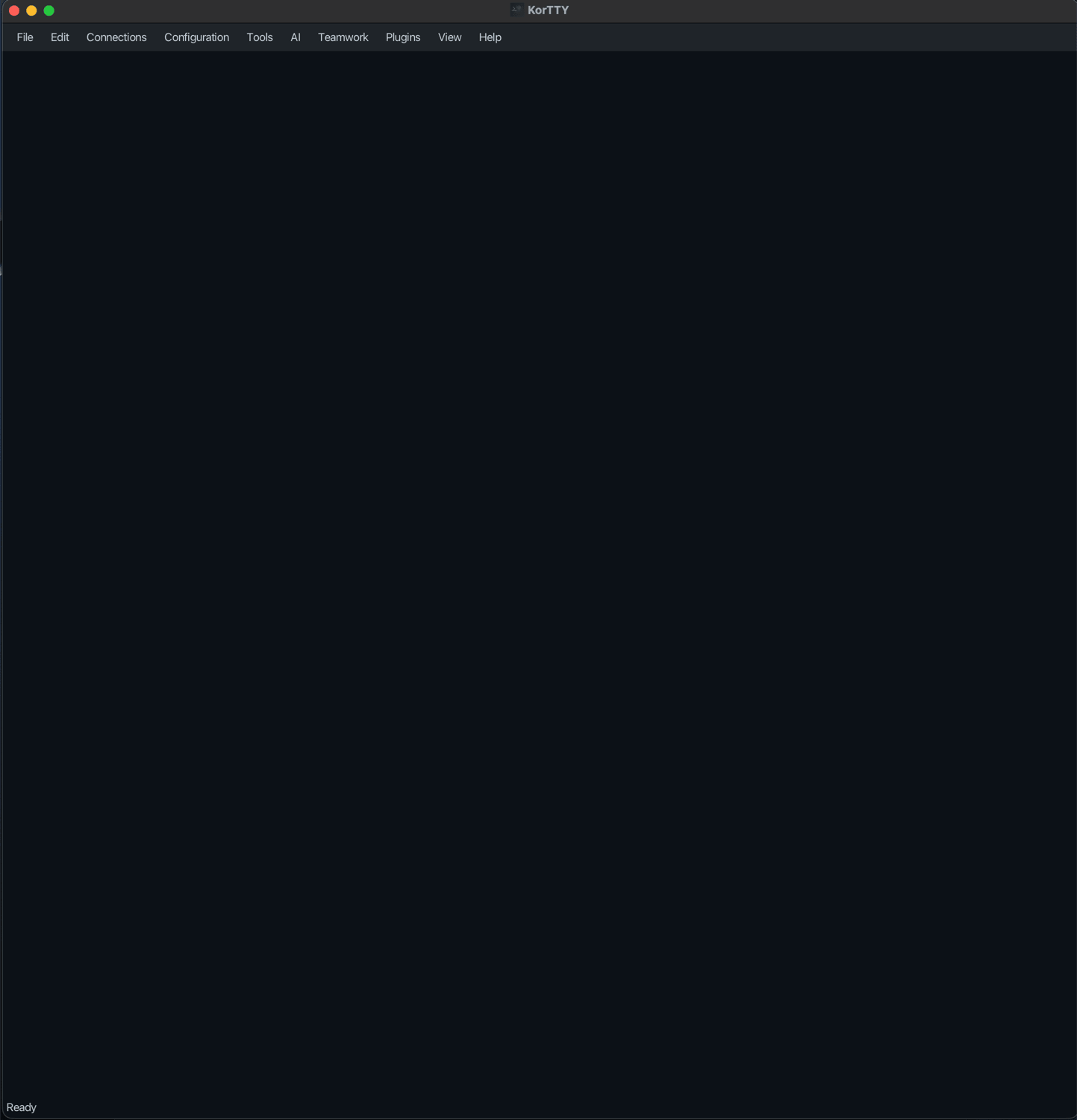
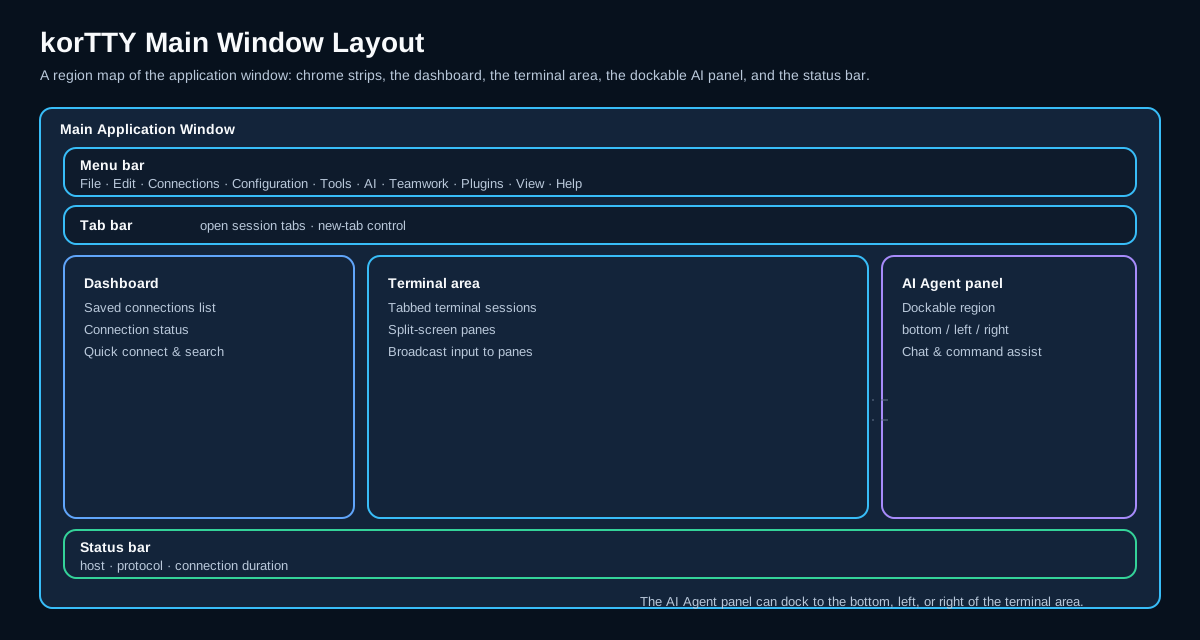
A fresh korTTY window: the menu bar, the terminal area (where session tabs and the optional dashboard appear once you connect), and the status bar. The following diagram maps the same regions:
korTTY's main window has these regions:
- Menu bar — File · Edit · Connections · Configuration · Tools · AI · Teamwork · Plugins · View · Help. All features are reachable here and via keyboard shortcuts. A live JobScheduler status menu appears after Help when a scheduled entry is active. While a guide translation runs, a progress indicator (bar, percentage and estimated time remaining) sits at the right end of the menu-bar row and stays visible even when the menu bar itself is hidden.
- Tab bar — each SSH/Mosh session runs in its own tab. Ctrl+T opens Quick Connect for a new tab; Ctrl+Tab / Ctrl+Shift+Tab switch tabs. With Open tool windows as tabs enabled (Window settings), management tools such as Snippets, the JobScheduler or the AI Manager open here as tabs too — in the window whose menu you used — instead of as separate windows.
- Dashboard (toggle Ctrl+Shift+D) — a side panel listing every open connection with status dots, protocol badges and AI-agent badges. See Dashboard below.
- File browser (View → File Browser ▸ Show on Left / Show on Right) — a dockable local file manager with navigation toolbar, path bar, filter, type icons and a folder/file/selection counter. Its side, width, hidden-file state and last directory are restored on the next launch. See File browser.
- Live journal panel (View → Live Journal, Ctrl+Alt+L) — the active tab's running session journal as its full journal page, docked and updating in real time; side and width are restored on the next launch.
- Terminal area — the active terminal, with optional split-screen and broadcast input.
- Status bar — connection state, host/IP, active protocol, temporary SSH-key timer and connection duration.
Terminal-only fullscreen
Press Ctrl+Shift+F (or View → Terminal-only Fullscreen) to show the whole korTTY window — menus, tabs and status bar included — kept at its previous window size and centered on an empty fullscreen background, so the desktop and other windows stop competing for attention. View → Hide terminal scrollbars in fullscreen removes the scrollbars too. A transparent terminal background becomes opaque while fullscreen is active and returns to its saved level when you leave. Press Ctrl+Shift+F again to restore.
Dashboard
Toggle the dashboard with Ctrl+Shift+D or View → Show Dashboard. It slides in on the left, sizes its width to the longest entry, and follows the active App Design's colors.
The header shows the panel title with two buttons: a collapse/expand toggle (collapses everything while any node is open, expands everything otherwise) and a refresh button. Below it, connections are organized as a tree:
- Main window — the root node, with an active/total session count.
- Environments — connections whose stored credential has an environment (for example Production or Test) are clustered under an environment node; connections without one sit directly under the main window.
- Groups — tabs assigned to a connection group appear under their group node. Saving a changed group in the Connection Manager updates open tabs immediately.
Each connection row shows a type icon, a status dot, the server name, and a protocol badge (ssh, mosh or local). The status dot distinguishes three states: filled green for a healthy connection, filled red for a connection that dropped unexpectedly (including a Mosh network interruption), and a hollow outline for a session that ended normally. Terminals with AI-agent runs carry the same ✋/⚡/⏸/✓ badge as elsewhere. Hovering a row shows user@host and the connection state; double-click (or Enter) focuses the session's tab.
Right-click a connection for Focus, Duplicate, Reconnect, SFTP-Client... (connected sessions only) and Close. A footer keeps a running "connected of total" count, and an empty panel shows a placeholder until the first session opens.
macOS Dock menu
On macOS, right-click (or Control-click) the korTTY icon in the Dock for quick actions without switching to the app — they apply to the current (focused) window, opening one first if none is open:
- New Window
- New Tab in Current Window
- Manage Connections… (Connection Manager)
- Open Project…
- Manual (the in-app guide)
- About korTTY
See the menu reference for every menu item and the keyboard-shortcuts reference for the full list of accelerators.